
On this page
TL;DRWhat is the Azure certification path?The three levelsWhat does the 2026 Azure certification path diagram look like?How to read the mapWhich Azure certification should beginners take first?Start somewhere else if the role says soA two-week starter routineWhat is the Azure certification path for administrators?What to practice before AZ-104What is the Azure certification path for developers?What is the Azure certification path for network and security engineers?Network trackSecurity trackWhat is the Azure certification path for solution architects, AI, and data engineers?Architect trackAI and data tracksHow long does it take to get Azure certified?Which Azure certification is best, and which can you skip?What should be on your Azure certification path checklist?Where should the study materials come from?Our perspectivePractice with SecLernFAQWhat is the Azure certification path for beginners?Do you need AZ-900 before AZ-104?Which Azure certification is best for a beginner software engineer?How long does it take to get Microsoft Azure certified?What is the hardest Azure certification?Do Azure certifications expire?SourcesRecommendedThe Azure certification path is role-based, not one mandatory ladder. Start with a fundamentals exam such as AZ-900 if Azure is new to you, then take the associate exam that matches the job you want: AZ-104 for administration, AZ-204 for development, AZ-500 for security, AZ-700 for networking, or AI-102 for AI. Consider an expert exam such as AZ-305 or AZ-400 only after that. Most Microsoft exams list recommended experience rather than requiring lower badges, so the best path is the shortest one that proves your target role.
TL;DR
- The Azure certification path is role-based: fundamentals (AZ-900, AI-900, DP-900, SC-900), associate exams by job role, then expert exams such as AZ-305, AZ-400 and SC-100.
- AZ-104 is the core administrator credential; AZ-204 serves developers, AZ-500 security engineers, AZ-700 network engineers, AI-102 AI engineers, and DP-700 or DP-100 data roles.
- Microsoft lists recommended experience for most exams, but AZ-400 has an associate-level prerequisite, so read each certification page.
- Planning estimates at 5 to 8 hours a week: 2 to 4 weeks for fundamentals, 8 to 12 weeks for associate, and 12 to 16 weeks plus project experience for expert.
- Role-based Microsoft certifications are valid for one year and renew through an online assessment on Microsoft Learn.
- Confirm the exam code on Microsoft's official certification page before buying materials; this map is current as of November 2026.
What is the Azure certification path?
The Azure certification path is an ordered route through Microsoft's Azure credentials, organized by level and role rather than one mandatory ladder. Microsoft's certification catalog sorts credentials into three levels, and most exams list recommended experience rather than an enforced lower certificate.
The three levels
- Fundamentals. Azure Fundamentals (AZ-900), AI-900, DP-900 and SC-900 cover vocabulary and service selection.
- Associate. AZ-104, AZ-204, AZ-500, AZ-700, AI-102, DP-700 and DP-100 are the role-based exams.
- Expert. AZ-305, AZ-400 and SC-100 assume associate-level knowledge and design judgment. The DevOps Engineer Expert page is the exception that lists an associate-level prerequisite.
The other exams mostly recommend experience without enforcing a lower badge. Beginners still start at fundamentals because it makes associate material readable, not because Microsoft checks.
A November 2026 note. Microsoft revises and retires exams. Before you buy a course or voucher, open the official certification page for your target exam and confirm the code and skills outline. This map is current as of November 2026; the official page always wins.
Do not collect badges. Two credentials that match your target role beat six that do not. Job postings tell you which code matters.
What does the 2026 Azure certification path diagram look like?
The 2026 Azure certification path diagram has three levels: fundamentals at the entry point, associate role tracks in the middle, and expert endpoints above them.
| Level | Certification | Exam | Best for | Next step |
|---|---|---|---|---|
| Fundamentals | Azure Fundamentals | AZ-900 | New to cloud: pricing, governance, core services | AZ-104, AZ-204 or AZ-500 |
| Fundamentals | Azure AI Fundamentals | AI-900 | AI vocabulary, no coding | AI-102 |
| Fundamentals | Azure Data Fundamentals | DP-900 | Data, analytics and database basics | DP-700 or DP-100 |
| Fundamentals | Security, Compliance, and Identity Fundamentals | SC-900 | Identity, compliance and security basics | AZ-500 |
| Associate | Azure Administrator Associate | AZ-104 | Cloud administrators and sysadmins | AZ-305, AZ-500 or AZ-700 |
| Associate | Azure Developer Associate | AZ-204 | Developers shipping code to Azure | AZ-400 or AI-102 |
| Associate | Azure Security Engineer Associate | AZ-500 | Security engineers applying Azure controls | SC-100 |
| Associate | Azure Network Engineer Associate | AZ-700 | Network engineers designing connectivity | AZ-305 |
| Associate | Azure AI Engineer Associate | AI-102 | Developers building AI services and APIs | Project work and specialist depth |
| Associate | Fabric Data Engineer Associate | DP-700 | Data engineers building Fabric pipelines | DP-100 or Fabric depth |
| Associate | Azure Data Scientist Associate | DP-100 | Data scientists training and deploying models | AI-102 or project work |
| Expert | Azure Solutions Architect Expert | AZ-305 | Architects designing secure, resilient systems | Specialist depth or renewal |
| Expert | DevOps Engineer Expert | AZ-400 | DevOps engineers owning CI/CD and release | AZ-305 or renewal |
| Expert | Cybersecurity Architect Expert | SC-100 | Security architects setting strategy | Renewal or specialist depth |
How to read the map
The map is deliberately simplified. Microsoft 365, Power Platform and Dynamics 365 tracks sit outside this Azure view. Inside Azure, the branch matters less than the job title: an administrator might move to AZ-305, AZ-500 or AZ-700 depending on the team.
Save or print this page as a PDF instead of hunting for older path diagrams. Confirm each exam code on the linked Microsoft page before booking, because Microsoft revises and retires exams.

Which Azure certification should beginners take first?
AZ-900, Microsoft Certified: Azure Fundamentals, is the right first exam for most beginners. It covers cloud concepts, core Azure services, pricing and support, and governance, as Microsoft's Azure Fundamentals page outlines, and it is the broadest entry point in the Azure catalog.
Start somewhere else if the role says so
- AI-900 if your target is AI or machine learning support work and you do not write code yet. It pairs with AI-102 later.
- DP-900 if you are moving into data analysis, data engineering or data science.
- SC-900 if your target is identity, compliance or a security operations center role.
- AZ-900 is not a job guarantee. It is a vocabulary exam. Hiring managers treat it as evidence that you can discuss subscriptions, resource groups and cost models, not as proof that you can run production workloads.
A two-week starter routine
- Week 1, one learning path. Work through the Azure Fundamentals path on Microsoft Learn, one module a day, and write five lines of your own summary after each module.
- Build the thing, then delete it. Create each service in the portal or with
azCLI commands, then delete the resource group so nothing billable keeps running. - Week 2, questions over rereading. Answer a short practice set after each module and log every miss with the reason you missed it. The AZ-900 Azure Fundamentals study page has explained question sets and labs. If you work full time, this realistic study plan shows how to fit modules into short sessions.
- Book when scores settle. Book once practice scores are stable across two sessions, not on a date picked before you started.
If you are torn between two entry points, the free Which Certification Fits Me? tool narrows the choice to one.
What is the Azure certification path for administrators?
The administrator path is AZ-900 if Azure is new, then AZ-104 Azure Administrator Associate, then one branch: AZ-305 for architecture, AZ-500 for security or AZ-700 for networking.
- Decide whether to skip AZ-900. Skip it only if you already work in Azure daily and can explain subscriptions, resource groups, RBAC and cost management without notes. Otherwise take it; two weeks of vocabulary makes AZ-104 far less painful.
- Take AZ-104. Microsoft Certified: Azure Administrator Associate is the core credential for identity, governance, storage, compute, virtual networking and monitoring. If you target cloud administrator roles, this is the code to search for in job ads.
- Choose the branch by team, not by prestige. Architecture teams want AZ-305, security teams want AZ-500, network teams want AZ-700. You can add a second branch later; the first should match the roles you are applying for now.
What to practice before AZ-104
- Resource groups, tags and Azure Policy assignments at different scopes.
- Role-based access control: built-in roles, custom roles, and why scope order matters.
- Storage accounts: replication options, access tiers, SAS tokens and stored access policies.
- Virtual networks: subnets, network security groups, peering, route tables and private endpoints.
- Load balancing choices, plus Azure Monitor, alerts and Log Analytics basics.
- The same tasks in the portal, Azure CLI and PowerShell, because exam questions switch between them.
If you do not have a subscription you are willing to break, browser-based hands-on labs let you click through the same tasks in a simulated environment.
How long (estimate). Plan on 8 to 12 weeks at 5 to 8 hours a week with some IT operations background. Working administrators may need less, but confirm readiness with a timed simulation.
What is the Azure certification path for developers?
The developer path is AZ-900 if Azure is new, then AZ-204 Azure Developer Associate, then AZ-400 DevOps Engineer Expert for delivery work or AI-102 if your target is AI application development.
- Take AZ-900 only if you need the vocabulary. Developers with no cloud background benefit from the pricing, governance and service-model modules. If you already deploy to Azure at work, skip it.
- Take AZ-204. Microsoft Certified: Azure Developer Associate tests compute, storage, security, monitoring, APIs, messaging and the code that connects an application to Azure services, for example managed identity, Key Vault, App Service, Functions and Cosmos DB.
- Pick the endpoint. DevOps Engineer Expert (AZ-400) if the target role owns CI/CD, infrastructure as code and release engineering. AI-102 if the target role builds AI services and APIs into products.
Worked example. A junior software engineer targeting a product team should plan AZ-900, then AZ-204, then AZ-400, and skip AZ-104 unless the job description also mentions cloud operations, on-call or infrastructure. A developer moving into an AI product team should plan AZ-900, AZ-204 and AI-102, with AZ-400 as optional.
Portfolio beats rereading. Two small projects make AZ-204 material stick: an API that authenticates with managed identity and reads secrets from Key Vault, and a pipeline that builds, tests and deploys it. Deploy them in a lab or free-tier subscription and write down what broke.
What is the Azure certification path for network and security engineers?
Network engineers follow AZ-900, then AZ-104, then AZ-700; security engineers follow SC-900, then AZ-500, then SC-100. Both tracks share an Azure administration foundation, which is why AZ-104 appears in both plans.
| Track | First exam | Core exam | Next step | What to practice |
|---|---|---|---|---|
| Network | AZ-900 | AZ-104, then AZ-700 | AZ-305 | VNets, subnets, peering, user-defined routes, VPN Gateway, ExpressRoute, Azure DNS, Azure Firewall, private endpoints |
| Security | SC-900 | AZ-500 | SC-100 | Microsoft Entra ID, conditional access, privileged identity management, Key Vault, Microsoft Defender for Cloud, Azure Policy, network security groups |
Network track
The Azure Network Engineer Associate (AZ-700) assumes you already understand routing, VPNs, DNS and segmentation. Do not jump straight to it without a networking base; take AZ-104 first or hold CCNA-level routing and switching knowledge. Cisco CCNA 200-301 routing and subnetting will feel familiar, but Azure-specific services such as ExpressRoute and Azure Firewall still need study.
Security track
SC-900 is broad Microsoft security, compliance and identity fundamentals. AZ-500 is narrower and more technical: it tests whether you can implement Azure controls, not just name them. SC-100 moves from implementation to strategy and suits engineers who already write security standards.
What is the Azure certification path for solution architects, AI, and data engineers?
Architects go AZ-900, then AZ-104, then AZ-305; AI engineers go AI-900, then AI-102; data engineers go DP-900, then DP-700; data scientists go DP-900, then DP-100.
| Route | Target role | Core exam | First project |
|---|---|---|---|
| Architect | Solutions architect | AZ-305, usually after AZ-104 | Design a three-tier web app with private endpoints, zone redundancy and a cost estimate |
| AI | AI engineer | AI-102, after AI-900 | Build a chat app that answers from your own documents using Azure AI Search |
| Data engineering | Fabric data engineer | DP-700, after DP-900 | Build an ingestion and transformation pipeline in Microsoft Fabric |
| Data science | Data scientist | DP-100, after DP-900 | Train, register and deploy a model in Azure Machine Learning |
Architect track
Microsoft Certified: Azure Solutions Architect Expert (AZ-305) does not formally require AZ-104, but the exam assumes you can implement what you design. Administrators who skip AZ-104 often spend the same weeks learning it anyway, without the credential, so take the administrator exam first.
AI and data tracks
AI-102 and DP-700 assume comfort with code and data pipelines. AI-102 asks you to build services, not describe them, so a developer background helps. DP-700 is Fabric-specific, with data factory patterns, lakehouse storage and notebooks rather than classic SQL Server administration. DP-100 suits people who already work with Python and model evaluation.
Choose by daily tasks. If your job involves writing APIs, AI-102 is closer than AZ-305. If it involves pipelines and data quality checks, DP-700 is closer than AI-102.
How long does it take to get Azure certified?
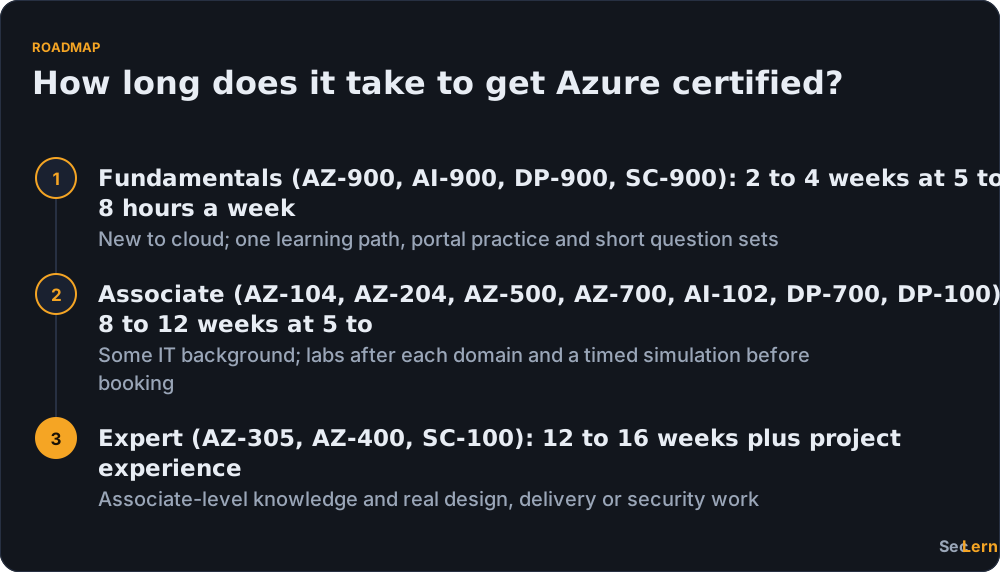
Plan on 2 to 4 weeks for a fundamentals exam, 8 to 12 weeks for an associate exam, and 12 to 16 weeks plus project experience for an expert exam. Microsoft publishes no required study time, so these are planning estimates.
| Level | Estimate | What the estimate assumes |
|---|---|---|
| Fundamentals (AZ-900, AI-900, DP-900, SC-900) | 2 to 4 weeks at 5 to 8 hours a week | New to cloud; one learning path, portal practice and short question sets |
| Associate (AZ-104, AZ-204, AZ-500, AZ-700, AI-102, DP-700, DP-100) | 8 to 12 weeks at 5 to 8 hours a week | Some IT background; labs after each domain and a timed simulation before booking |
| Expert (AZ-305, AZ-400, SC-100) | 12 to 16 weeks plus project experience | Associate-level knowledge and real design, delivery or security work |
Prior Azure experience can cut an associate estimate roughly in half, while complete beginners should add two to four weeks of cloud fundamentals review. Consistency matters more than total hours, because Azure skills are recall-heavy. This system for retaining technical knowledge explains why short review cycles beat rereading. Practice scores should be consistent before you book, not a single lucky run.
Exam prices, scheduling options and testing policies vary by country and exam version. Microsoft's certification page links to the current exam page, which shows price and appointment options at booking. Check there rather than in a blog post, including this one.
Which Azure certification is best, and which can you skip?
The best Azure certification is the one that matches the role you are applying for, and the safest to skip are duplicate fundamentals and associate exams that never appear in your target job postings.
- Best by role. AZ-900 for beginners, AZ-104 for administrators, AZ-204 for developers, AZ-500 for security engineers, AZ-700 for network engineers, AZ-305 for architects, AI-102 for AI engineers, and DP-700 or DP-100 for data roles.
- Most popular. AZ-900 is the common entry point and the exam most people meet first. Microsoft does not publish exam-volume rankings, so treat any popularity list as anecdote.
- Hardest. Microsoft publishes no difficulty ranking. Expert exams such as AZ-305, AZ-400 and SC-100 are generally harder for most candidates than fundamentals, because they assume associate-level knowledge and design judgment. Among associate exams, difficulty is personal.
- Safe to skip. A second fundamentals exam that does not match your role. An associate exam that never appears in your target job listings. AZ-104 if you will only write application code or build models and never operate infrastructure.
- Before you buy a voucher. Search ten local job postings for the exam code and read the renewal rules on Microsoft Learn. If a code appears in none of the postings you would apply for, that is your answer.
If you are still comparing roles, these IT certification study pages list every path by exam code and level.
What should be on your Azure certification path checklist?
The checklist has five phases: pick one target role and exam code, complete a study path with hands-on labs, use practice questions and a timed simulation, book on the official exam page, then update your profiles and plan renewal.
- Pick one target role and one exam code. Confirm the exam is active on Microsoft Learn and read the skills outline. Choose the code that appears in job ads you would actually apply for.
- Complete a study path and build something. Work through the Microsoft Learn path for that exam and deploy each service once. Notes in your own words beat highlighted documentation.
- Use practice questions, performance-based questions (PBQs) and a full timed simulation. Review every missed question until you can explain why the wrong answers are wrong. Book only when two simulation scores are consistent.
- Check the official page, then book. Confirm the exam code, price, scheduling options and testing policy on Microsoft's site, and make sure your ID matches the name on the registration.
- Update your profiles and plan renewal. Add the credential to your resume and LinkedIn the week you pass, then read the renewal rules on Microsoft Learn so the one-year clock does not surprise you.
Where should the study materials come from?
Microsoft Learn is the free baseline: official learning paths and the skills outline for every exam, with sandboxes in many modules. John Savill's Technical Training on YouTube suits long deep dives and exam crams. Pluralsight and A Cloud Guru offer video libraries and cloud sandboxes, often useful when an employer pays. MeasureUp and Whizlabs sell practice test banks that mimic the exam interface. SecLern fits early exams, with original questions, graded PBQs and browser labs in one place; its Azure coverage centers on AZ-900 and SC-500, so for AZ-104 and above, pair Microsoft Learn with real portal time.
Print the checklist and check the five phases off as you go.
Our perspective
We built SecLern around the order most people get wrong: they buy a course bundle before they pick the exam code. The Azure catalog is wide enough that a path diagram can point you at AZ-305 when the jobs you want list AZ-104, or the other way around. The advice is boring but reliable: open the official certification page, read the skills outline, then scan ten local job ads for the same code. If the code never appears in the ads, the badge is a hobby. The honest trade-off is that SecLern's Azure catalog is narrow today, AZ-900 and SC-500, so for AZ-104 and above we point people to Microsoft Learn plus real portal time.
Practice with SecLern
SecLern's AZ-900 Azure Fundamentals study page is built for the first step on this path: original practice questions with an explanation for every answer, graded performance-based questions, full timed exam simulations with readiness grades, and browser-based hands-on labs that need no Azure subscription. The free tier needs no card and includes the first module, 30 questions a day, 3 labs and PBQs, and unlimited flashcards. Pro is $15 a month or $99 a year with a 7-day trial, and Exam Sprint is $29 once for 90 days if your exam date is already booked.
FAQ
What is the Azure certification path for beginners?
Start with Microsoft Certified: Azure Fundamentals (AZ-900) to learn cloud vocabulary, core services, pricing and governance. Then pick one associate exam that matches the job you want: AZ-104 for administration, AZ-204 for development, AZ-500 for security or AZ-700 for networking. AI-900, DP-900 and SC-900 are alternative fundamentals for AI, data and security roles. Microsoft lists recommended experience, so a fundamentals exam is not a formal prerequisite.
Do you need AZ-900 before AZ-104?
No. The Azure Administrator Associate page lists recommended experience rather than a required certificate, so AZ-104 has no enforced prerequisite. AZ-900 is still worth two to four weeks if subscriptions, resource groups and cost models are new to you, because AZ-104 assumes you can find your way around the portal. Working administrators often skip AZ-900 and go straight to AZ-104.
Which Azure certification is best for a beginner software engineer?
AZ-204, Microsoft Certified: Azure Developer Associate, is the core credential, because it tests code that connects applications to Azure services. AZ-900 is a useful warm-up but does not prove development skill. A sensible route is AZ-900, then AZ-204, then AZ-400 if the role owns delivery pipelines, or AI-102 if it builds AI features. Skip AZ-104 unless the job also covers cloud operations.
How long does it take to get Microsoft Azure certified?
Microsoft does not publish study times, so plan with estimates. Roughly 2 to 4 weeks at 5 to 8 hours a week for a fundamentals exam such as AZ-900, 8 to 12 weeks for an associate exam such as AZ-104, and 12 to 16 weeks plus real project experience for an expert exam such as AZ-305. Prior Azure work shortens each estimate.
What is the hardest Azure certification?
Microsoft publishes no difficulty ranking. In practice, expert exams such as AZ-305, AZ-400 and SC-100 are harder for most candidates than fundamentals, because they assume associate-level implementation knowledge and design judgment. Among associate exams, difficulty depends on your background: a developer may find AZ-204 easier than AZ-104, while a network engineer may find AZ-700 easier than AZ-500.
Do Azure certifications expire?
For role-based credentials, yes. Microsoft states that role-based certifications are valid for one year and renew through an online assessment on Microsoft Learn; see the renewal rules. The renewal article addresses role-based certifications, so check the renewal section on your specific certification page if you hold a fundamentals credential. Note the expiry date the week you pass and set a calendar reminder.
Sources
- Browse Microsoft Certifications
- Microsoft Certified: Azure Fundamentals
- Microsoft Certified: Azure Administrator Associate
- Microsoft Certified: Azure Developer Associate
- Microsoft Certified: Azure Solutions Architect Expert
- Microsoft Certified: DevOps Engineer Expert
- Microsoft Certified: Azure Security Engineer Associate
- Microsoft Certified: Azure AI Fundamentals
- Microsoft Certified: Azure AI Engineer Associate