On this page
TL;DRTable of ContentsWhat a CompTIA PBQ actually isSimulations versus virtual environmentsWhich exams include PBQsHow PBQs are scoredTiming and order: how to handle PBQs on exam dayA simple exam-day routineHow to practice PBQs so the skills stickStep 1: Start from the exam objectivesStep 2: Learn the formats before you master the contentStep 3: Do the task with a clock, then withoutStep 4: Review every miss by causeStep 5: Rotate across domainsPBQ practice by examWhy hands-on labs belong alongside PBQsOur perspective on PBQ practiceStart practicing PBQs on SecLernFAQHow many PBQs will I get on a CompTIA exam?Can I skip a PBQ and come back to it?Do I get partial credit on PBQs?Is there only one correct way to solve a PBQ?What is the best way to practice CompTIA PBQs?SourcesRecommendedThe best way to prepare for CompTIA performance-based questions (PBQs) is to do the tasks yourself, in a simulated environment, until the steps feel routine. Reading about a firewall rule or a subnet mask is not the same as configuring one with a timer running. This guide explains what PBQs are, how they are scored, how to handle them on exam day, and how to build a practice routine that fits the exam you are taking.
TL;DR
- PBQs ask you to complete a task, not pick an answer. CompTIA delivers them as either simulations or virtual environments, and the two behave differently.
- You can skip a simulation PBQ and come back to it. You cannot do that with a virtual PBQ, which must be completed when you meet it.
- Scoring details are confidential, but CompTIA says partial credit may be offered on some PBQs and that more than one path to the correct result can earn credit.
- Practice by performing the task end to end, then reviewing why each step mattered. Repeat across the objectives, not just your favorite topics.
Table of Contents
- What a CompTIA PBQ actually is
- How PBQs are scored
- Timing and order: how to handle PBQs on exam day
- How to practice PBQs so the skills stick
- PBQ practice by exam
- Our perspective on PBQ practice
- Start practicing PBQs on SecLern
- FAQ
- Sources
What a CompTIA PBQ actually is
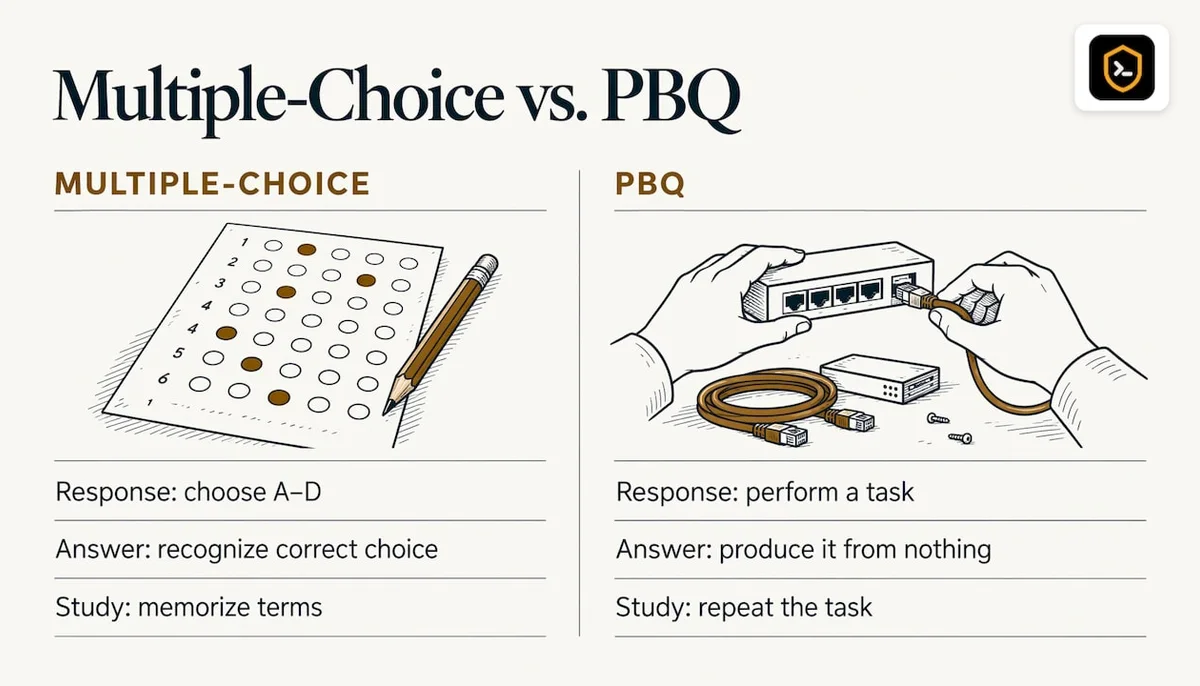
CompTIA describes PBQs as items that test your ability to solve problems in real-world settings. Instead of choosing A, B, C or D, you act. You might drag components onto a network diagram, read a scan output and decide what to fix, write a firewall rule, or work in a terminal window.
That difference changes how you study. A multiple-choice item lets you recognize a correct answer when you see it. A PBQ makes you produce the answer from nothing. If you have only memorized terms, the blank screen exposes it quickly. If you have done the task several times, it feels familiar.
Simulations versus virtual environments
CompTIA separates PBQs into two formats, and knowing which one you are looking at matters on exam day.
- Simulations are an approximation of an environment or tool, such as a firewall, a network diagram, a terminal window or an operating system. Functionality is restricted, but there can be several possible responses or paths.
- Virtual environments are full virtual machines running select operating systems and software. Because they are real, all manner of incorrect steps can be pursued.
Both descriptions come from CompTIA's official PBQ overview. The practical takeaway is that simulations are bounded and forgiving, while virtual environments reward real command-line and configuration skill.
Which exams include PBQs
CompTIA's overview lists simulation PBQs on A+, Network+, Security+, CySA+, PenTest+, Linux+, Server+, Cloud+, Data+, DataSys+, DataAI, CloudNetX and Project+. If you are sitting any of the mainstream certifications, plan on meeting them. The same page notes that exams are reevaluated every three years, and CompTIA expects the number of PBQs to grow over time. Treat PBQ practice as a core part of your plan from day one, not a final-week add-on.
How PBQs are scored
CompTIA keeps the exact scoring confidential, but it has said enough to shape your strategy:
- PBQs are scored in real time by Pearson VUE, for both in-person and online testing.
- Some PBQs may offer partial credit and others may not. Some may carry higher point values than others.
- If there is more than one way to reach a correct answer, you receive a correct score when the correct solution is achieved.
- CompTIA does not publish the point values for each question or the total points on an exam.
What this means for you: do not assume a PBQ is worth the same as a multiple-choice item, and do not assume a half-finished PBQ earns nothing. Aim to complete the task correctly, but if time is short, a partially correct configuration may still be better than leaving it blank. You cannot know the weighting, so the safest approach is to attempt every item.
Timing and order: how to handle PBQs on exam day
Timing is where many candidates lose points on PBQs, usually by sinking too much time into one task. Here is what CompTIA says about the format.
For A+, CompTIA states that exams include multiple-choice, drag-and-drop and performance-based items, with no more than 90 questions and 90 minutes. Network+ N10-009 has the same ceiling, with a maximum of 90 questions in 90 minutes, per the official exam objectives.
Two details deserve attention. CompTIA says that most PBQs appear at the beginning of the exam, and that you will not see a clock while working on each one. Network+ is described the same way. That combination catches people off guard: the hardest, longest items come first and the timer is hidden.
A simple exam-day routine
- Identify the type. Simulation PBQs have a reset button and cover the entire testing area. Virtual PBQs do not, and a warning screen appears before you enter one.
- Read the instructions fully. In a simulation PBQ, the question and instructions are always available and can be minimized, moved and resized. Keep them open while you work.
- Decide whether to skip. A simulation PBQ can be skipped and revisited. If one looks like a time sink, flag it, move to the multiple-choice items and return with the time you have left.
- Commit to virtual PBQs. You cannot skip them, so when you meet one, complete it then.
- Check your work before leaving. Make sure each change you made is applied and saved, and compare your final state with the task wording.
CompTIA's own overview of these tips is on the PBQ overview page. Read it once before your exam so the screens are not a surprise.
How to practice PBQs so the skills stick
Good PBQ practice has three parts: seeing the format, doing the task, and reviewing your mistakes. Skipping any of them leaves a hole.
Step 1: Start from the exam objectives
CompTIA recommends reviewing the exam objectives and taking a practice test simulation to get a sense of the PBQs you will face. The objectives tell you which tasks are fair game. Turn each verb in the objectives (configure, implement, analyze, troubleshoot) into a task you can physically perform, then practice that task.
Step 2: Learn the formats before you master the content
PBQs repeat a handful of patterns. Across the certifications, you will see things like:
- Matching or placing components on a diagram (network devices, security controls).
- Interpreting output, such as scan results or logs, then choosing a fix.
- Building a rule or policy, such as a firewall rule or access list.
- Ordering steps in a process, such as an incident response or troubleshooting sequence.
- Working in a command line or settings interface to change a configuration.
Once you recognize the pattern, the content is easier to recall because you know what the question is asking you to produce.
Step 3: Do the task with a clock, then without
Because you will not see a per-question clock on exam day, build your own sense of pace. CompTIA recommends timed practice for A+ that assesses pace, average time per question and interface familiarity. Run some PBQs timed, to learn how long a typical task takes you. Run others untimed, to focus on getting every step right and understanding why.
Step 4: Review every miss by cause
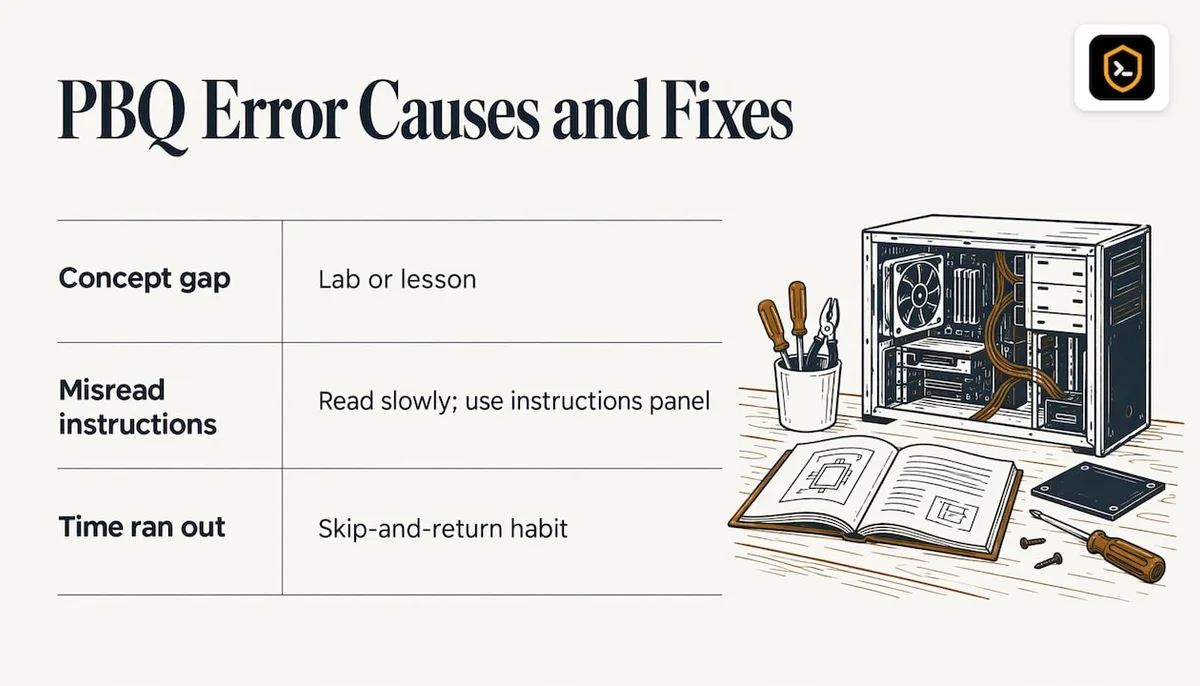
After each attempt, sort errors into three buckets: you did not know the concept, you knew it but misread the instructions, or you ran out of time. Each needs a different fix. Concept gaps need a lab or a lesson. Misreading needs slower reading and use of the instructions panel. Time problems need the skip-and-return habit.
Step 5: Rotate across domains
It is tempting to repeat the tasks you already like. Instead, rotate through every domain in the objectives. PBQs can pull from any of them, and the weakest domain is usually where you lose the most.
PBQ practice by exam
Each exam favors different tasks. Here is where to start for the most common ones, with SecLern pages that show the formats.
| Exam | Typical PBQ focus | Where to practice |
|---|---|---|
| Security+ SY0-701 | Security controls, firewall rules, log and incident analysis | SY0-701 PBQ examples |
| Security+ SY0-801 | Same skill families on the newer objectives | SY0-801 PBQ examples |
| Network+ N10-009 | Network diagrams, configuration, troubleshooting | N10-009 PBQ examples |
| PenTest+ PT0-003 | Scan output, attack planning, reporting | PT0-003 PBQ examples |
| A+ Core 1 220-1201 | Hardware, mobile, networking, troubleshooting | A+ Core 1 practice test |
| A+ Core 2 220-1202 | Operating systems, security, software troubleshooting | A+ Core 2 practice test |
If you are also looking at Cisco's track, there are CCNA 200-301 PBQ examples too. For a full list by exam, see the PBQ examples library.
Why hands-on labs belong alongside PBQs
PBQs in a virtual environment behave like real systems, so reading is a weak substitute. Working in a lab teaches the muscle memory a PBQ tests: where a setting lives, what a command returns, what breaks when you skip a step. If you are preparing for Network+, the Network+ N10-009 labs give you that practice in the browser. For A+, there are labs for 220-1201 and 220-1202, and the same approach works for Linux+ XK0-006 and CySA+ CS0-004.
Our perspective on PBQ practice
We built SecLern around one belief: if the exam asks you to do something, you should have done it before. A PBQ is a small, timed job, and the candidates who handle it calmly are the ones who have already performed that job several times.
That is why our labs and PBQs are graded on whether the task was actually completed, not on whether you clicked something plausible. Immediate feedback and explanations tell you what went wrong while the steps are still fresh, and adaptive study sessions are designed to steer you toward the gaps you keep showing instead of the topics you already know.
We also write our own questions rather than recycling copied lists. Our PBQs are mapped to the published exam objectives, so each task you practice traces back to something the certification actually covers. The aim is competence you can demonstrate, not answers you can recite.
If you take only one habit from this guide, make it this: never review a PBQ by looking at the answer alone. Redo the task from a blank state until you can explain every step.
the author
Start practicing PBQs on SecLern
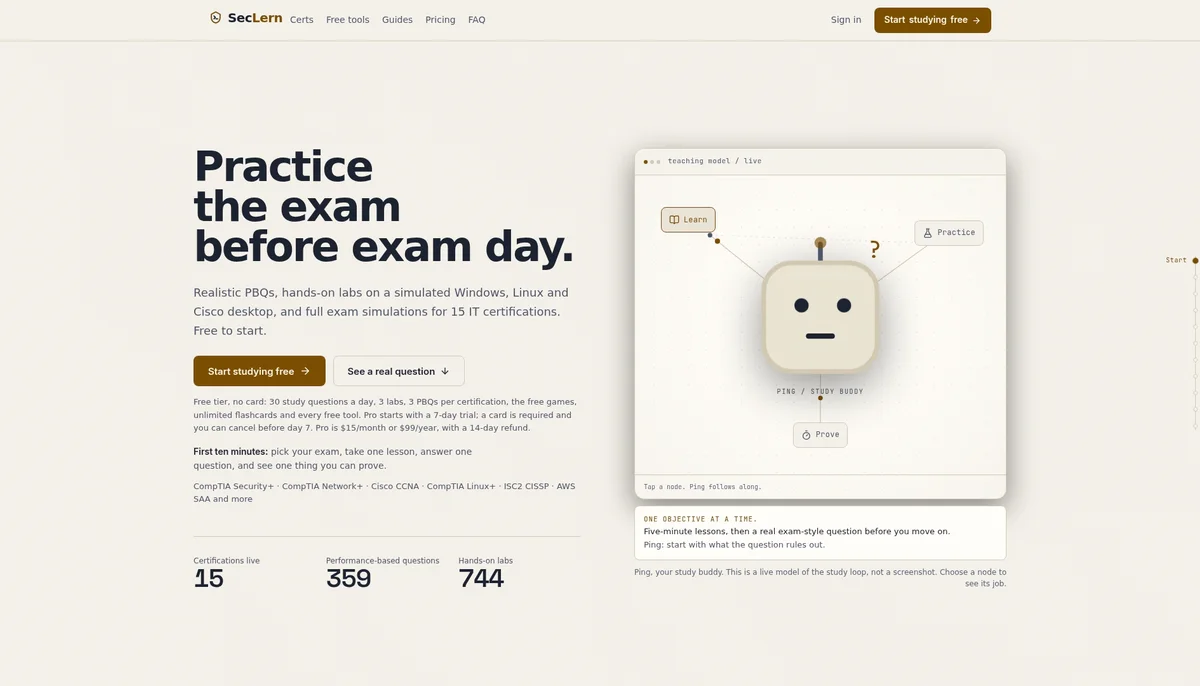
SecLern is an IT certification prep platform with original practice questions, hands-on labs in simulated Windows, Linux and Cisco environments, and PBQs mapped to exam objectives. You can start on the free tier, which has limited access to key features, and move up when you want the full set.
Paid options are straightforward. Pro is $15 per month or $99 per year. Exam Sprint is a one-time $29 payment for 90 days of access, which suits a fixed exam date. See the details on the pricing page, or browse the hands-on labs for 15 certification exams first.
FAQ
How many PBQs will I get on a CompTIA exam?
CompTIA does not publish a fixed number, and it expects PBQs to increase over time as exams are updated. What it does say is that most appear at the start of the exam. Check the current exam objectives for your certification, and plan to practice many formats rather than a set count.
Can I skip a PBQ and come back to it?
It depends on the type. CompTIA says simulation PBQs can be skipped and revisited, while virtual PBQs must be completed when you encounter them, with a warning screen before you enter. Learn to tell the two apart so you know your options in the moment.
Do I get partial credit on PBQs?
CompTIA says some PBQs may offer partial credit and others may not, and that point values can differ between questions. Exact scoring is confidential. Because of that, attempt every PBQ and aim to complete as much of the task correctly as you can.
Is there only one correct way to solve a PBQ?
Not always. CompTIA states that if more than one path leads to a correct answer, you receive a correct score when the correct solution is achieved. Focus on the end state the task asks for, and keep your steps clean so you can verify the result.
What is the best way to practice CompTIA PBQs?
Use the exam objectives as your checklist, practice each task in a simulated or lab environment, and time yourself on some attempts. Review each miss by cause: concept gap, misread instructions or time. Repeat across every domain, not just your strongest.
Sources
- Performance-Based Questions Overview, CompTIA
- Performance-Based Questions FAQs, CompTIA Blog
- What Is a Performance-Based Question?, CompTIA Blog
- How To Study for CompTIA A+, CompTIA Blog
- What Is on the CompTIA A+ (1101/1102) Exam?, CompTIA Blog
- What Is on the CompTIA Network+ Exam?, CompTIA Blog
- CompTIA Network+ Certification Exam Objectives